
WhatsApp for Coaching Institutes: Automate Admission Enquiries & Fee Reminders (2026)
A 2026 playbook for Indian coaching institutes: capture every admission enquiry, reply in 60 seconds, and collect fees on WhatsApp — legally, on autopilot.
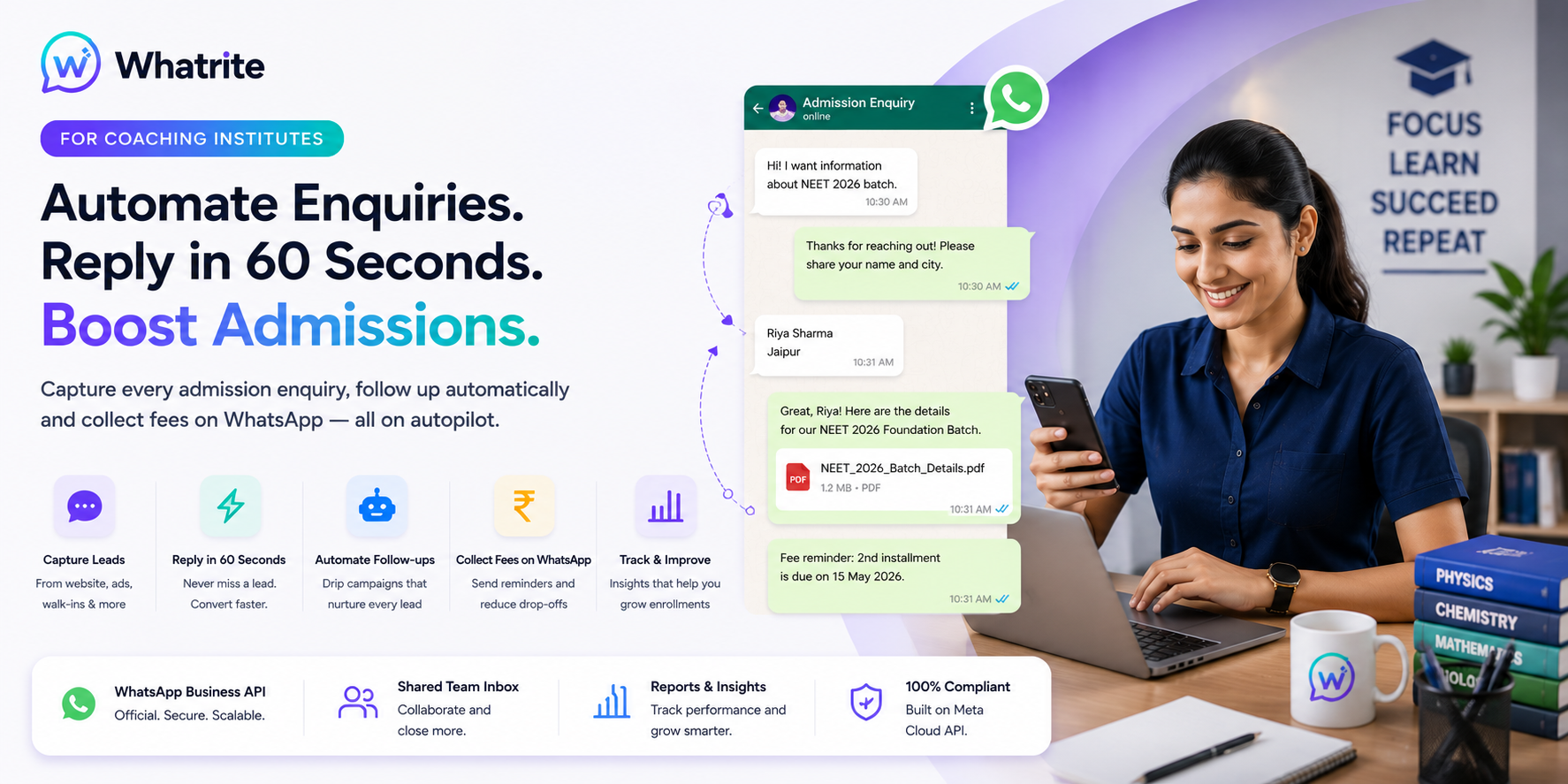
Most coaching institutes in India already run on WhatsApp — enquiries land there, batch groups live there, fee reminders go out from there. The problem isn't the channel. It's that all of it runs off a personal WhatsApp on the counsellor's phone: enquiries get missed after 9pm, follow-ups depend on someone remembering, and when a counsellor quits, the leads leave with them.
This guide is a practical 2026 playbook for turning that chaos into a system. No jargon, no "digital transformation" — just the three jobs WhatsApp should be doing for your institute, and how to automate each one.
Why WhatsApp, specifically, for coaching
Parents and students don't open email and don't answer unknown calls. They do read WhatsApp — message open rates sit in the 90%+ range versus ~20% for email. For an admissions decision that happens over days of back-and-forth (fees, batch timings, demo class, "let me ask my father"), a channel people actually check is the whole game.
But there's a catch that most institutes learn the hard way: personal WhatsApp and WhatsApp Business App were not built for this. No two counsellors can share one number, there's no way to auto-reply instantly, broadcast lists cap at 256 and get your number flagged, and you have zero record of who said what. That's why serious institutes move to the WhatsApp Business API — and why we wrote a full breakdown of the hidden cost of running a coaching business on personal WhatsApp.
The API unlocks three jobs. Let's automate them.
Job 1 — Capture every admission enquiry (and reply in 60 seconds)
The single biggest leak in coaching admissions is response time. A parent who fills your "Book a Free Demo" form at 10pm and hears nothing until 11am the next day has already messaged two other institutes. Speed-to-lead is the difference between an enrolled student and a competitor's WhatsApp thread.
Set this up:
- Point every enquiry source into WhatsApp. Website form, Instagram/Facebook lead ads, and a "Chat on WhatsApp" button. The highest-intent source is a Click-to-WhatsApp ad — the parent taps the ad and lands directly in a chat, no form friction.
- Auto-reply instantly, 24×7. The moment an enquiry hits, an automated flow greets them by name, confirms the course they asked about, and offers the next step: *"Hi Priya 👋 Thanks for your interest in our NEET 2027 batch. Would you like (1) fee details, (2) a free demo class, or (3) to talk to a counsellor?"
- Route to the right counsellor. The lead gets auto-assigned so nothing sits unowned, and the human takes over exactly when needed.
The principle here — automate the first response, keep the human for the real conversation — is one we've covered in depth in how to automate lead response in 60 seconds without losing the human touch.
Reality check: automation isn't about replacing your counsellor. It's about making sure no enquiry ever waits — so your counsellor spends their day talking to warm leads, not chasing cold ones.
Job 2 — Nurture the "let me think about it" leads
Very few parents enrol on the first message. Most go quiet — comparing fees, timings, and results. If your only follow-up is a counsellor manually texting "Ma'am, any update?" three times, you'll lose most of them to fatigue on *your* side, not theirs.
This is what an automated **drip sequence** is for. Once a lead goes cold, enrol them into a timed series that does the convincing for you:
- Day 0: Demo class invite + a 30-second student result reel
- Day 2: Topper testimonial / batch success rate
- Day 4: Fee structure + any early-bird / sibling discount
- Day 6: "Batch filling fast — X seats left" nudge with a payment link
Each message is spaced, personalised, and stops the instant the parent replies or enrols. Done right, a drip recovers 15–25% of leads that a manual process would have dropped. We break down the mechanics — timing, message types, and the mistakes that get numbers blocked — in the complete guide to WhatsApp drip campaigns that convert.
Job 3 — Collect and recover fees (the part that pays for itself)
Fee follow-up is where coaching institutes burn the most staff hours and lose the most money — installments slip, cheques bounce, and the "I'll pay next week" never arrives. WhatsApp fixes this better than any channel, because you can attach a payment link right inside the reminder.
A working fee-reminder system looks like this:
- T-3 days: *"Hi Mr. Sharma, Aarav's Term 2 fee of ₹18,000 is due on 5th July. Pay securely here: [link]"*
- Due date: a short reminder with the same link.
- T+2 days (overdue): a firmer nudge, optionally flagged for the accounts team to call.
- On payment: an automatic receipt confirmation.
Here's the part most institutes miss — and it's the one that saves you money. Under Meta's current rules, utility templates (like fee reminders and receipts) sent inside an open 24-hour service window are free, and service replies are free and unlimited. So if a parent messages you and you send the reminder within 24 hours, that message costs you *nothing*. Understanding this "free window" is worth real money at scale — we explain it fully in the WhatsApp 24-hour window, explained.
What this actually costs in 2026
Coaching owners always ask "so what's the WhatsApp bill?" Short version, and it's cheaper than people fear:
- Since 1 July 2025, Meta charges per delivered message, not per conversation window.
- Utility messages (fee reminders, receipts, class updates) cost roughly ₹0.11–0.13 each — and are free inside the 24-hour service window.
- Marketing messages (promos to old leads, new-batch announcements) cost roughly ₹0.80–0.90 each as of January 2026.
- Service replies (your counsellor answering a parent) are free and unlimited since November 2024.
- On top of Meta's charges you pay your platform fee, and 18% GST applies.
For a mid-size institute, the monthly WhatsApp cost is typically a rounding error against a single recovered admission. The full math — with the markups BSPs don't advertise — is in the true cost of WhatsApp Business API in India (2026).
Doing it legally: opt-in, templates, and student data
Automating WhatsApp doesn't mean spamming. Two rules keep your number safe and your institute compliant:
- Get opt-in. Only message people who've contacted you or ticked a consent box. Buying a "student database" and blasting it is the fastest way to get your number banned.
- Use approved templates for the first message. Any message you send outside the 24-hour window must be a pre-approved template. Coaching templates get rejected for predictable reasons — promotional language in a utility template, placeholder errors, missing opt-out. Save yourself the back-and-forth with the WhatsApp template rejection reasons & Meta approval guide.
One coaching-specific note: if you collect data on minors, India's DPDP framework requires verifiable parental consent. In practice, route enquiries about under-18 students through the parent's number and keep consent on record.
Setup: do you need the full API?
If you're a single tutor with 30 students, the free WhatsApp Business App is fine. You need the Business API the moment any of these are true:
- More than one person answers enquiries
- You want auto-replies, drips, and fee reminders on autopilot
- You run more than one branch or brand number (a single dashboard for managing multiple WhatsApp Business accounts becomes essential here)
- You want your leads and chat history to survive a counsellor leaving
The API isn't something you install — you run it through a platform. That's the whole reason platforms like whatrite exist: the API power, without the developer work.
Your 30-day rollout plan
You don't need to boil the ocean. Sequence it:
- Week 1 — Capture: move to the API, set up the instant auto-reply and one "Book a demo" flow. Stop losing after-hours enquiries first.
- Week 2 — Route: connect your enquiry sources (website, lead ads, CTWA) and turn on auto-assignment to counsellors.
- Week 3 — Nurture: build one 4-message drip for cold leads. Ship it, watch the recovery rate.
- Week 4 — Collect: set up utility fee-reminder templates with payment links and the auto-receipt.
By day 30 you've plugged the three biggest leaks — missed enquiries, dropped follow-ups, and slipping fees — without adding a single staff hour.
FAQ
Is it legal to send fee reminders on WhatsApp in India?
Yes, as long as the parent has opted in (contacted you or consented) and reminders go via approved utility templates. Utility messages inside the 24-hour service window are also free.
Can I use my existing coaching WhatsApp number?
You can migrate a number to the WhatsApp Business API, but it can no longer be used in the regular WhatsApp/Business App at the same time. Many institutes move their main enquiry number to the API and keep a personal number separate.
How much does WhatsApp automation cost a coaching institute per month?
Meta charges per message — utility messages ~₹0.11–0.13 (free inside the 24-hour window), marketing ~₹0.80–0.90 — plus your platform fee and 18% GST. For most institutes it's a small fraction of one recovered admission.
Will automation make my institute feel impersonal?
No, if you automate the right layer: instant first response and reminders on autopilot, humans for the actual conversation. That combination usually feels more responsive to parents, not less.
Do I need a developer to set this up?
No. You use a WhatsApp Business API platform — the API capability without any coding.
Ready to run admissions on autopilot?
whatrite gives Indian coaching institutes one dashboard to capture every enquiry, reply in 60 seconds, nurture cold leads, and collect fees on WhatsApp — API-grade, no developer needed.