
The true-cost / hidden-markup piece (highest priority)
Discover the real WhatsApp Business API pricing in India for 2026. Compare Meta's official rates, GST impact, BSP markups, hidden charges, and calculate your true messaging costs before choosing a provider.
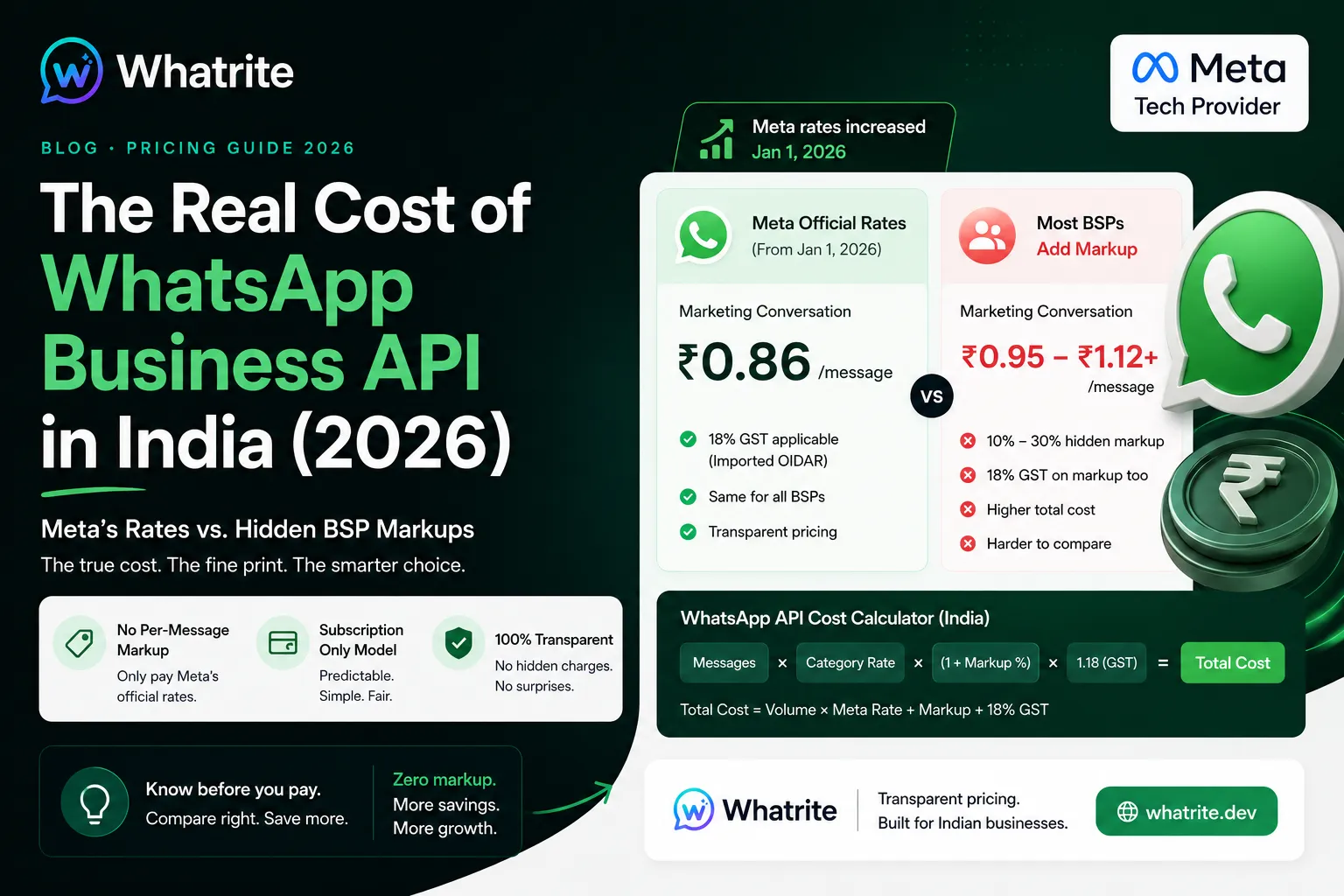
If you're comparing WhatsApp Business API providers in India, you've likely seen wildly different pricing quotes for what is essentially the same underlying service.
One provider quotes ₹0.90 per message. Another quotes ₹1.10. A third asks you to contact sales for custom pricing.
This creates an obvious question:
If all providers ultimately use Meta's WhatsApp infrastructure, why are the costs so different?
The answer is surprisingly simple: most businesses aren't paying only Meta's charges. They're also paying BSP markups, platform fees, and GST—often without realizing how much of their invoice comes from each component.
At Whatrite, we've spoken to businesses that assumed they were paying Meta's official rates, only to discover months later that their provider was adding a significant margin on every message sent.
That's why understanding WhatsApp Business API pricing isn't just about knowing Meta's rates. It's about understanding your true cost of ownership.
How WhatsApp Business API Pricing Actually Works
When you use WhatsApp Business API, there are typically three separate cost components:
1. Meta Messaging Charges
These are the official charges set by Meta for WhatsApp conversations and message categories.
For Indian businesses, marketing messages remain one of the most common chargeable categories. Following Meta's pricing updates, businesses need to carefully track these costs as messaging volume grows.
No provider controls these rates. Every BSP is subject to the same underlying Meta pricing structure.
2. BSP Markup
This is where pricing starts to differ.
Many Business Solution Providers (BSPs) add their own margin on top of Meta's charges. Depending on the provider, this markup can range from 10% to 30% or even higher.
The challenge is that this markup isn't always disclosed separately. Instead, businesses often see a single blended message rate, making it difficult to understand what portion goes to Meta and what portion goes to the provider.
3. Platform Fees and GST
Most providers also charge:
- Monthly subscriptions
- CRM fees
- Team inbox fees
- Automation fees
- Chatbot fees
On top of this, GST is applicable on both messaging charges and platform subscriptions.
The result is that the amount you actually pay can be substantially higher than the pricing advertised on a landing page.
The Hidden-Markup Problem Most Businesses Miss
Let's look at a practical example.
Imagine your business sends 100,000 marketing messages in a month.
Assume Meta's cost is approximately ₹0.86 per message.
Scenario A: Provider With 20% Markup
Meta charges:
100,000 × ₹0.86 = ₹86,000
Provider markup:
20% of ₹86,000 = ₹17,200
Subtotal:
₹103,200
GST (18%):
₹18,576
Total:
₹121,776
Scenario B: Whatrite's Zero-Markup Model
Meta charges:
₹86,000
Provider markup:
₹0
Platform subscription:
Fixed monthly software fee
GST:
Applied transparently
Instead of paying an inflated rate on every message, you pay Meta's actual charges and a predictable software subscription.
As message volume increases, the difference becomes even more significant.
Why Whatrite Doesn't Mark Up Meta Charges
Most BSPs earn a portion of their revenue by increasing the cost of every message sent.
This creates a conflict of interest.
The more messages you send, the more they earn from markup.
At Whatrite, we believe businesses should know exactly what they're paying for.
That's why our pricing philosophy is simple:
- Pay Meta's actual messaging charges
- No per-message markup
- No hidden conversation inflation
- Flat platform subscription
- Transparent billing
We earn revenue from our software platform—not by increasing Meta's costs.
This allows growing businesses to scale WhatsApp marketing, support, and automation without worrying about hidden percentage-based charges eating into margins.
WhatsApp API Cost Calculator for India
To calculate your actual monthly cost, use this formula:
Total Cost = Meta Charges + BSP Markup + Platform Fee + GST
Let's compare.
10,000 Messages Per Month
Meta Cost:
₹8,600
Provider with 20% markup:
₹10,320 before GST
Whatrite:
₹8,600 before GST
Difference:
₹1,720 every month
100,000 Messages Per Month
Meta Cost:
₹86,000
Provider with 20% markup:
₹103,200 before GST
Whatrite:
₹86,000 before GST
Difference:
₹17,200 every month
500,000 Messages Per Month
Meta Cost:
₹430,000
Provider with 20% markup:
₹516,000 before GST
Whatrite:
₹430,000 before GST
Difference:
₹86,000 every month
Over a year, that's more than ₹10 lakh in additional costs simply because of markup.
Nothing changed about WhatsApp.
Nothing changed about Meta.
Only the provider's pricing model changed.
Questions You Should Ask Before Choosing Any WhatsApp BSP
Before signing with any provider, ask these five questions:
Do you add markup on Meta's messaging charges?
If yes, ask for the exact percentage.
Can I see Meta's charges separately?
Transparent providers should be able to clearly separate Meta costs from platform costs.
Is GST applied on both messaging and software fees?
Understanding tax implications helps avoid invoice surprises.
What happens as my volume grows?
Some providers increase effective costs through pricing tiers or custom quote structures.
How do you generate revenue?
This simple question often reveals whether a provider relies on software subscriptions or message markups.
Beyond Pricing: What Businesses Actually Need
Choosing a WhatsApp provider shouldn't be based solely on message rates.
The platform should also help you generate more revenue and operate more efficiently.
That's why Whatrite combines transparent pricing with business-focused features, including:
- Official WhatsApp Cloud API access
- Shared team inbox
- WhatsApp CRM
- Broadcast campaigns
- Automated workflows
- Lead management
- Contact segmentation
- Analytics and reporting
- Multi-agent support
- No-code automation capabilities
The goal isn't just to send messages.
The goal is to convert leads, automate support, and build stronger customer relationships—without paying unnecessary markups on every conversation.
Why More Businesses Are Switching to Zero-Markup Pricing
As WhatsApp becomes a primary channel for sales, support, and marketing, businesses are becoming more sophisticated about cost management.
Finance teams want predictable billing.
Operations teams want transparency.
Founders want to avoid hidden fees.
That's why many growing businesses are moving away from providers that bundle markups into messaging costs and toward platforms that separate software value from Meta's pricing.
The subscription-only model is easier to understand, easier to budget for, and often significantly cheaper at scale.
Final Thoughts
The biggest mistake businesses make when evaluating WhatsApp Business API pricing is comparing only the advertised message rate.
The real comparison should be:
Meta Charges + Markup + Platform Costs + GST
Once you break down the numbers, the differences between providers become much clearer.
At Whatrite, we believe businesses shouldn't have to guess where their money is going. That's why we follow a transparent pricing model where Meta's messaging charges are passed through without markup, while our platform subscription covers the software, automation, CRM, and collaboration tools that help businesses grow.
Before choosing a WhatsApp BSP in 2026, ask one simple question:
"Am I paying Meta's actual cost—or am I paying someone else's markup?"
The answer could save your business thousands—or even lakhs—of rupees every year.