
The Hidden Cost of Running Your Coaching Business on Personal WhatsApp
Personal WhatsApp costs you more than you think—lost leads, missed replies, scattered conversations. Here's what growing coaches do differently.
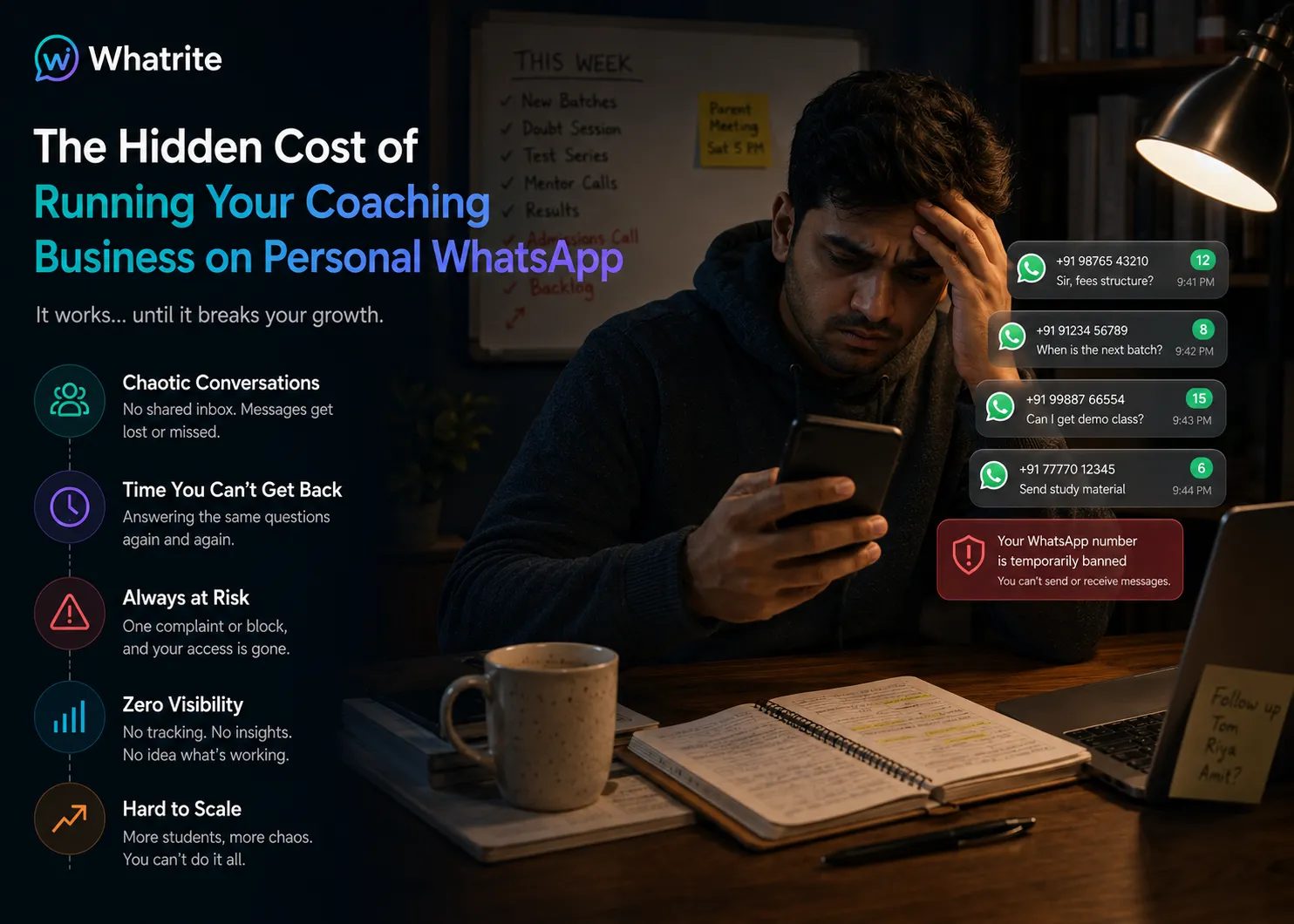
It is 9 PM on a Tuesday in May. Your JEE registration deadline is in 48 hours. Your best counsellor, Priya, is typing out individual messages to 340 parent contacts when WhatsApp throws up a ban screen. Not a warning. A ban. Her number, her phone, her two years of parent relationships, gone in the time it takes to refresh.
This is not a hypothetical. It is the week that derails admission cycles for coaching institutes across India every single year. And the uncomfortable truth is that it was entirely preventable, not by working harder, but by moving off personal WhatsApp before the cracks became canyons.
Why 50 Students Works on Personal WhatsApp (and 500 Does Not)
Personal WhatsApp is fine when you have 50 students. You know every parent by name. Your counsellor can hold the entire student database in their head. Sending a class schedule update takes 10 minutes and everyone gets it.
At 500 students across three batches, that same update becomes 500 individual messages. Your counsellor is now sending batch-specific timetables, fee reminders, and doubt-clearing slot announcements to overlapping groups of parents. The volume looks identical to bulk spam to WhatsApp's automated systems, even though every single message is legitimate and requested.
At 5,000 students with 15 Counsellors and multiple centre branches, personal WhatsApp is not just inconvenient. It is actively costing you money. Parents who did not get the fee reminder do not pay on time. Students who could not reach anyone at 11 PM choose a competitor. When Priya resigns, she takes 340 parent phone numbers that you technically cannot use without rebuilding from scratch.
The platform that powered your growth is now blocking your next stage of growth. Here is why, and what to do about it.
Breaking Point One: The Ban Risk on Bulk Sends
WhatsApp's acceptable use policy flags accounts for temporary or permanent bans when message volume and frequency cross certain thresholds, even within the 24-hour business messaging window. For a coaching institute running JEE or NEET admission campaigns, that threshold is not hard to cross.
You send an announcement to 300 parents about a new batch starting in June. You send fee reminders to 450 parents in the same week. You follow up individually with 120 parents who have not confirmed their child's seat. To WhatsApp's algorithm, this looks like a spam operation. To you, it is Tuesday.
Other WhatsApp SaaS tools have addressed this by distributing sends across multiple phone numbers. Whatrite takes a different approach by connecting directly to Meta's WhatsApp Business API, which is designed for the volume and template requirements that high-volume communication involves. This does not make you immune to Meta's policies, but it shifts your operation from grey-area personal use to sanctioned business use with proper rate limiting and template governance built in.
Breaking Point Two: No After-Hours Coverage
Parents have questions at 11 PM. Students panic about exam dates on Sunday evening. A parent wants to know if the scholarship amount can be adjusted before the Monday deadline. These are legitimate queries, and they arrive when your counsellor is asleep.
Personal WhatsApp has no concept of business hours. Either your counsellor is always available, or parents wait until 9 AM and by then they have already called three competitor institutes.
The solution is not to expect humans to work around the clock. The solution is to have an AI layer that handles the predictable, repetitive queries using your actual data. Whatrite lets you train an AI assistant on your specific syllabus structure, fee slabs, batch timings, and scholarship policies. When a parent asks "what is the last date to pay the second installment for the JEE dropper batch", the bot answers from your real document, not a generic response. Your counsellor reviews the flagged queries in the morning and handles the ones that actually need a human touch.
How This Looks in Practice
A parent messages your number at 11:30 PM asking about the NEET crash course schedule and whether installments are available. The AI bot responds immediately with the current batch timetable and the EMI option your institute offers. The parent gets a response in seconds. Your counsellor wakes up to a clean inbox with three conversations flagged for manual follow-up, not 47 unread messages.
Breaking Point Three: Lost Institutional Memory
When Priya leaves, she takes her chat history. Her notes on which parents are waiting for a scholarship decision. Her understanding that Mr. Sharma from Kota has been following your institute for two years and is ready to convert if you call this week. None of that lives in your system because it lived in her personal WhatsApp.
You can ask her to forward chats, but she is busy at her new job. And the forwarded chats do not include the context she built over two years of conversations. You are starting from zero with 340 parent contacts that now sit in your CRM without any history.
A shared team inbox solves this at the structural level. Every conversation lives in a central dashboard that belongs to the institute, not the individual. When a new counsellor picks up a parent thread, they see the full history of interactions, what was promised, what was asked, and where the conversation left off. Whatrite stores this history as a managed, queryable record so that when your senior counsellor goes on leave, the replacement does not start cold.
Breaking Point Four: Zero Visibility Into Response Accountability
You have 12 Counsellors. How many parent queries were responded to yesterday? How many are still waiting? Which batch has the highest unresolved query rate? Who followed up on the scholarship interest from the last open house?
On personal WhatsApp, you cannot answer any of these questions without asking every counsellor individually and hoping their logs are accurate. You are running a business communication operation with the visibility of a group chat.
A proper student communication platform gives you a dashboard view. You see open tickets, average response time per counsellor, query categories by batch, and conversion signals from admission interest to confirmed enrollment. You can identify that the JEE dropper batch has a 40 percent query abandonment rate this week and route additional support before you lose those students to a competitor.
What the Fix Looks Like: Shared Inbox, AI Bot, and Drip Sequences
These four breaking points have three corresponding solutions that work together as a system, not as disconnected features.
A Shared Inbox That Scales With Your Team
Your Counsellors log in to a shared dashboard rather than their personal phones. They see assigned conversations, queue depth, and priority flags. When Priya leaves, her queue transfers to the next counsellor with full history intact. Your institute retains the relationship data, not the individual device.
An AI Assistant That Knows Your Timetable and Fee Structure
You upload your current batch schedules, fee documents, and common FAQ categories. The AI layer answers the predictable queries automatically, flags questions it cannot resolve, and hands off to a human with full context. Parents get responses in seconds at any hour. Counsellors start their day with a manageable task list instead of an overflowing inbox.
Drip Sequences for Student and Parent Onboarding
When a student enrols, they enter an automated sequence. Day one brings a welcome message with batch details and counsellor introduction. Day three sends the first study schedule. Day seven reminds about the first fee installment. Day 14 checks in on whether the student has joined the WhatsApp study group. This is not a broadcast blast; it is a structured, personalised progression that keeps students engaged without your counsellor typing the same 15 messages manually to every new admission.
Whatrite supports these drip sequences with proper template management so your messages stay within WhatsApp's business messaging guidelines, reducing the risk of the ban scenario that opened this post.
Moving Off Personal WhatsApp Before the Admission Season Crisis
The scenario at the top of this post has a predictable arc. The counsellor loses access. Your team scrambles to re-add parents to a new number. Some parents do not see the new number because they never saved it. Your admission numbers for that batch drop 15 percent because the JEE registration reminder never reached 40 families in time.
That 15 percent is not an acceptable loss. It is a preventable one. Moving your student communication to a proper WhatsApp for coaching institutes setup before your next peak admission season means you are running on sanctioned business infrastructure, with shared team access, AI-assisted response, and automated sequences that do not depend on any single person being available at midnight.
Personal WhatsApp got you here. It will not get you to the next stage.