
Broadcast vs Drip vs Flow: Which WhatsApp Automation to Use When
Broadcast, drip and flow aren't three flavours of the same feature. One question - who started the conversation - decides which one you need. Here's the rule, the cost math, and the failure mode hiding in each.
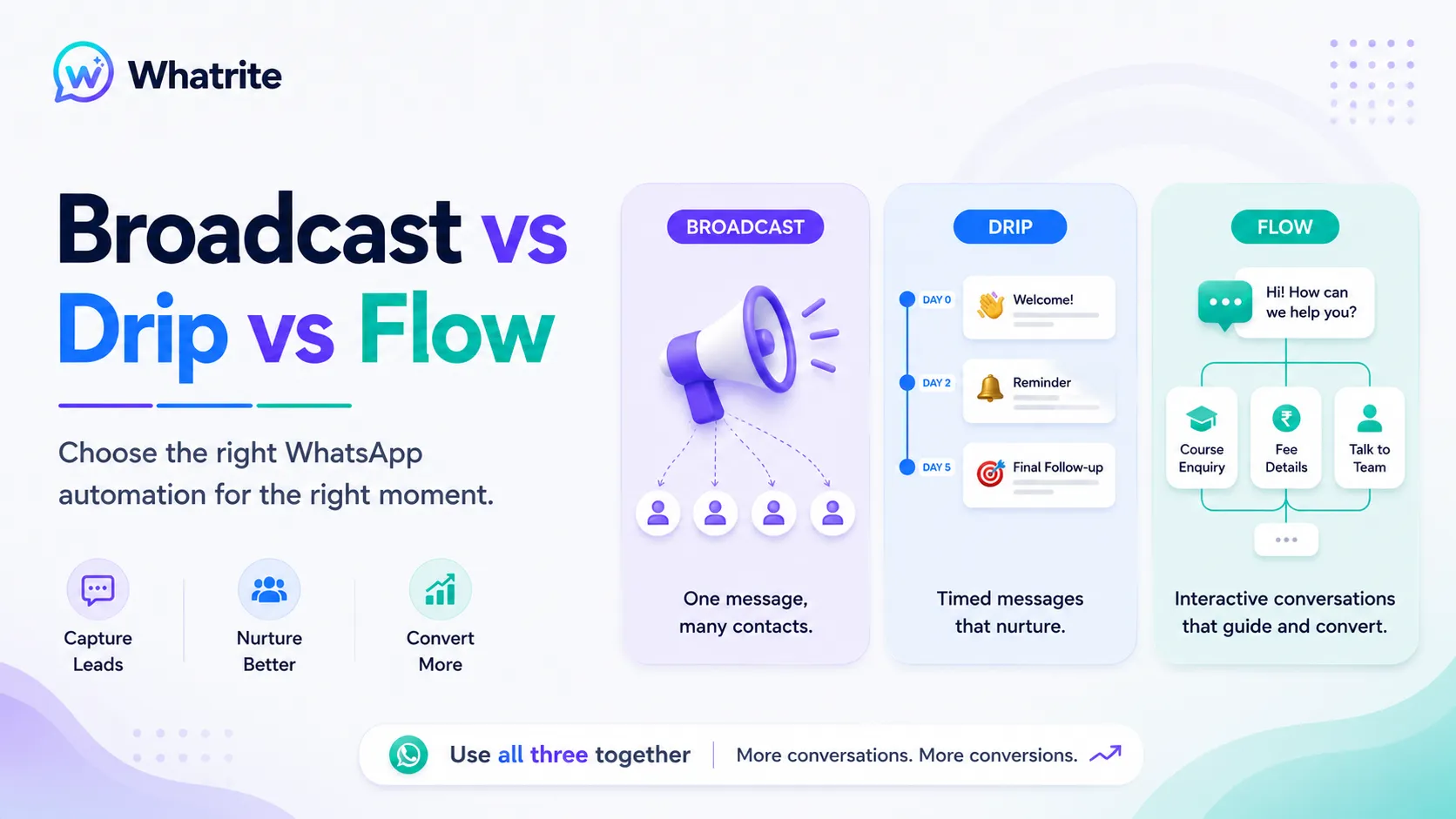
Most teams that struggle with WhatsApp automation don't have a copywriting problem or a tooling problem. They have a selection problem - they reach for a broadcast when the situation called for a flow, get a 2% response rate, and conclude that "WhatsApp doesn't work for us."
Broadcast, drip and flow are not three flavours of the same feature. They're three different answers to three different questions, and the boundary between them is technical, not stylistic. Once you see where that boundary sits, choosing takes about five seconds.
The one question that decides everything
Before you compare features, ask: who is starting this conversation, and is a window already open?
WhatsApp draws a hard line between business-initiated and user-initiated messaging. When a customer messages you, a 24-hour window opens in which you can send free-form messages - any text, any media, any buttons, no approval needed. Outside that window, you can only send pre-approved templates, and each one costs money. (We've unpacked the mechanics in the WhatsApp 24-hour window, explained.)
That line maps almost perfectly onto the three tools:
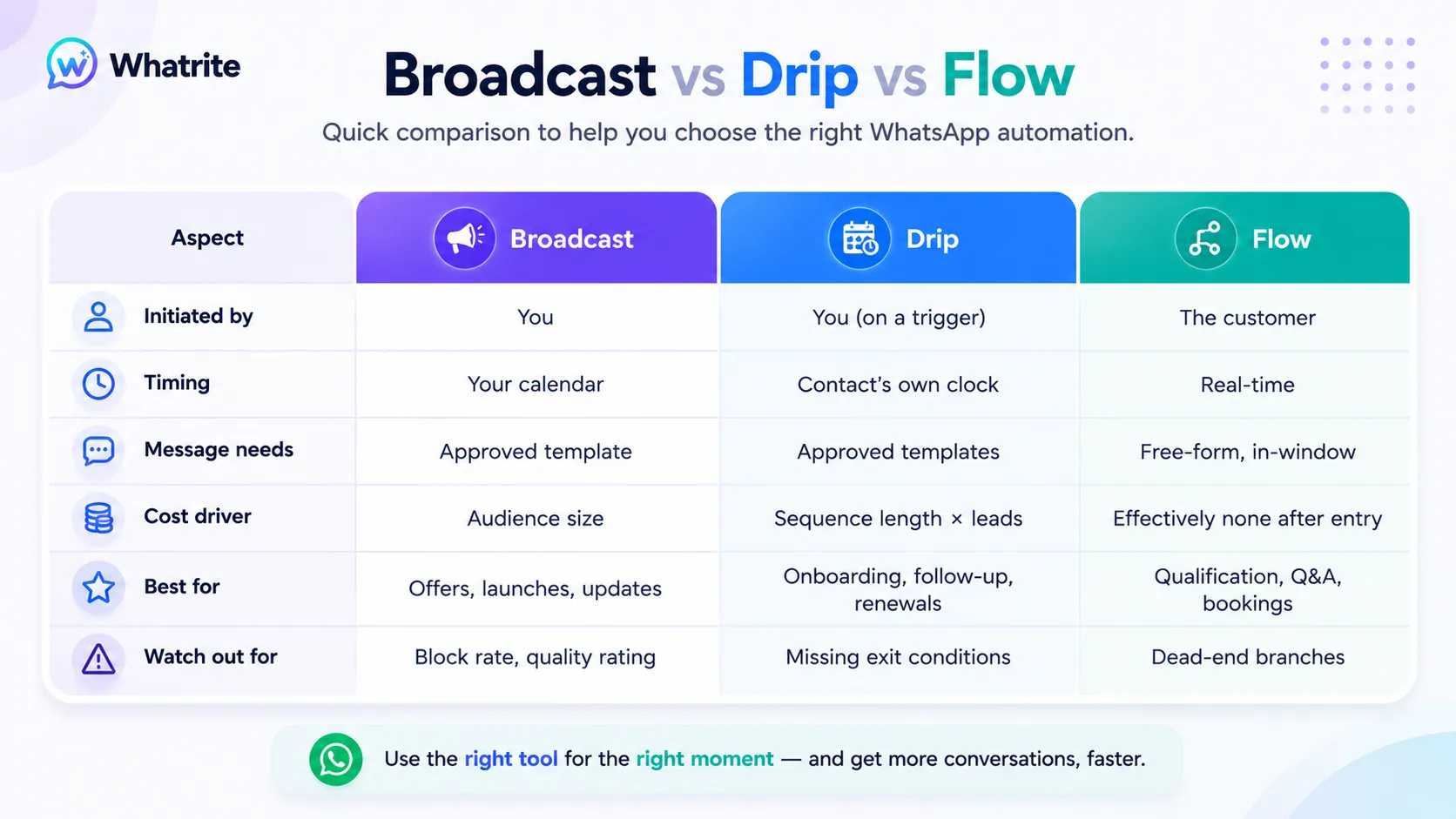
- Broadcast and Drip are business-initiated. They reach out. They need templates, they need Meta approval, and they cost per message.
- Flow is *user-initiated*. It runs inside an open window, on free-form messages, at effectively zero messaging cost.
So the real question isn't "which feature is best." It's: *is the customer already talking to me?* If yes, a flow does the work. If no, you're paying to reopen the conversation — and then the choice is between one message to many (broadcast) or many messages over time to one (drip).
Broadcast: when the message doesn't change
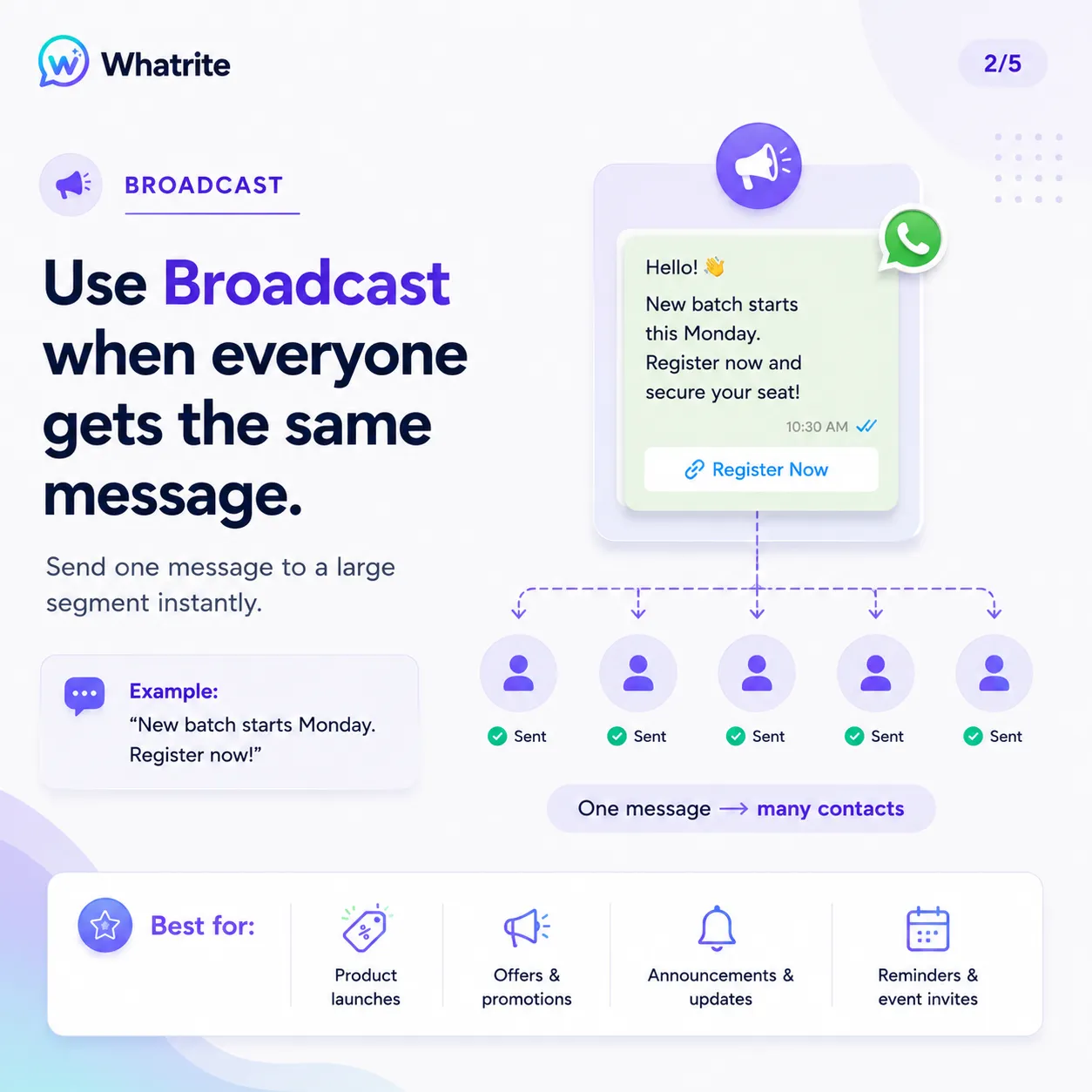
A broadcast is one approved template sent to a segment, right now. New batch starting Monday. Diwali offer live till Sunday. Maintenance window tonight. Everyone gets the same thing, and the value is in the timing and the reach, not the personalisation.
Use it when: the content is genuinely identical across the audience, it's tied to a moment, and no reply is strictly required for it to have done its job.
The failure mode nobody plans for. Broadcast is the only one of the three that can quietly damage your account. Every send is a chance for a recipient to hit *Block* or *Report*, and Meta uses those signals to set your quality rating and your daily messaging limit. Two enthusiastic promotional blasts to a stale list can drop a number from a 10,000/day tier to a 1,000/day tier — and the tier you lose on Tuesday is the tier you needed on Friday.
So the metric that matters for broadcasts isn't open rate (it'll be high; it's WhatsApp). It's block rate. Segment before you send, keep an opt-out path on every marketing template, and never broadcast to contacts who have never messaged you.
Drip: when the message depends on time
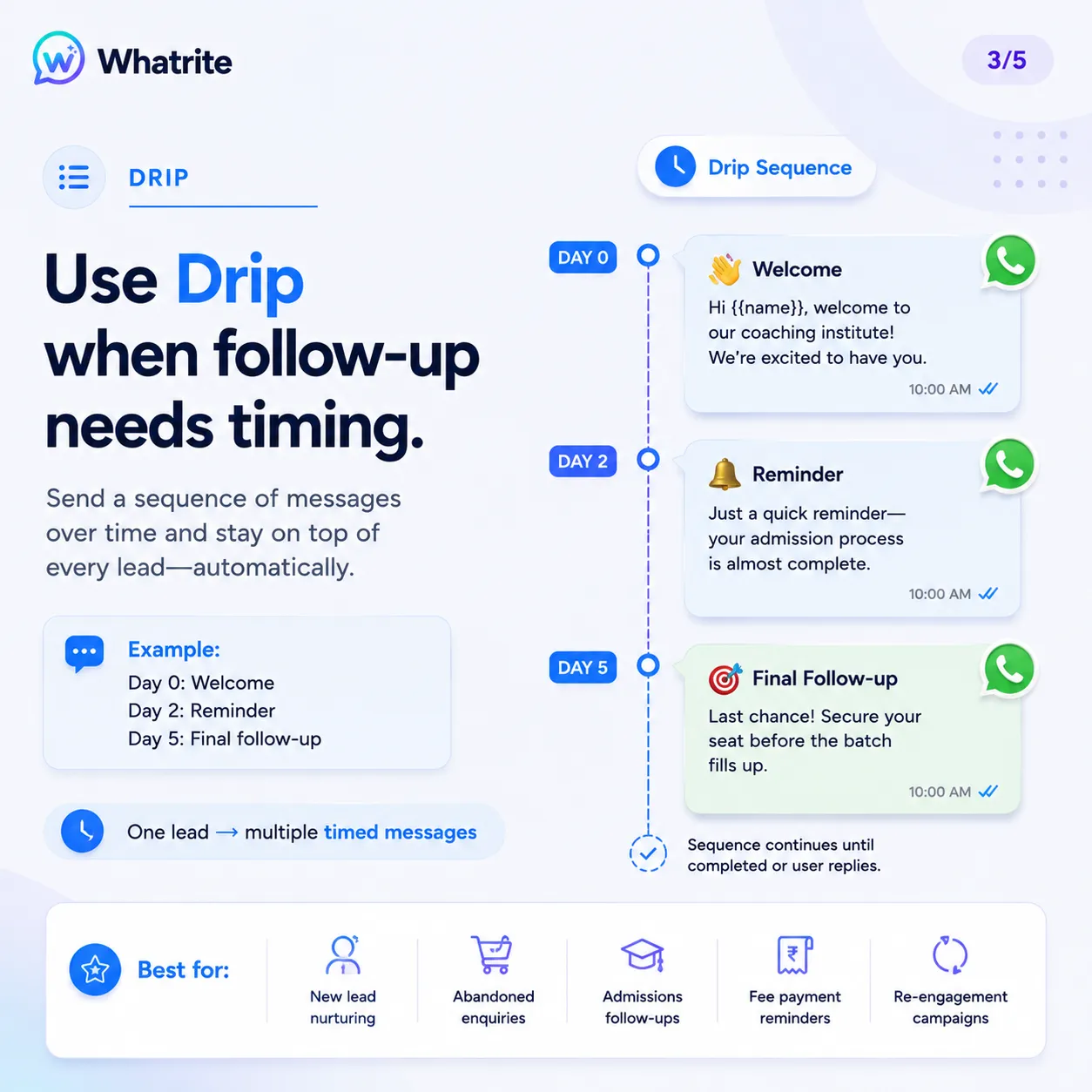
A drip is a sequence - Day 0, Day 2, Day 5 - that a contact enters on a trigger and moves through on a clock. Same list of messages, but each contact walks it from their *own* start date. That's the difference from a broadcast: a broadcast is anchored to your calendar, a drip is anchored to the contact's.
Use it when: the decision takes days, not minutes. New-lead nurture, abandoned enquiries, admission follow-ups, fee reminders, renewals, win-back.
Drip is where most teams find their unglamorous ROI, because it replaces the one task humans reliably fail at: remembering to follow up a fourth time. A lead that goes cold on day one usually isn't dead, just not ready. We go deeper on cadence and message design in the complete guide to WhatsApp drip campaigns that convert.
The failure mode: exit conditions, not copy. The classic bug is a drip that keeps firing after the person has already replied, already paid, or already enrolled elsewhere. Nothing torches trust faster than "just checking if you're still interested?" landing two days after someone paid you.
Before you write a single line of a sequence, write down what stops it: a reply, a conversion event, a tag change, an opt-out. A drip without exit conditions isn't nurture, it's a leak.
Flow: when the message depends on the answer
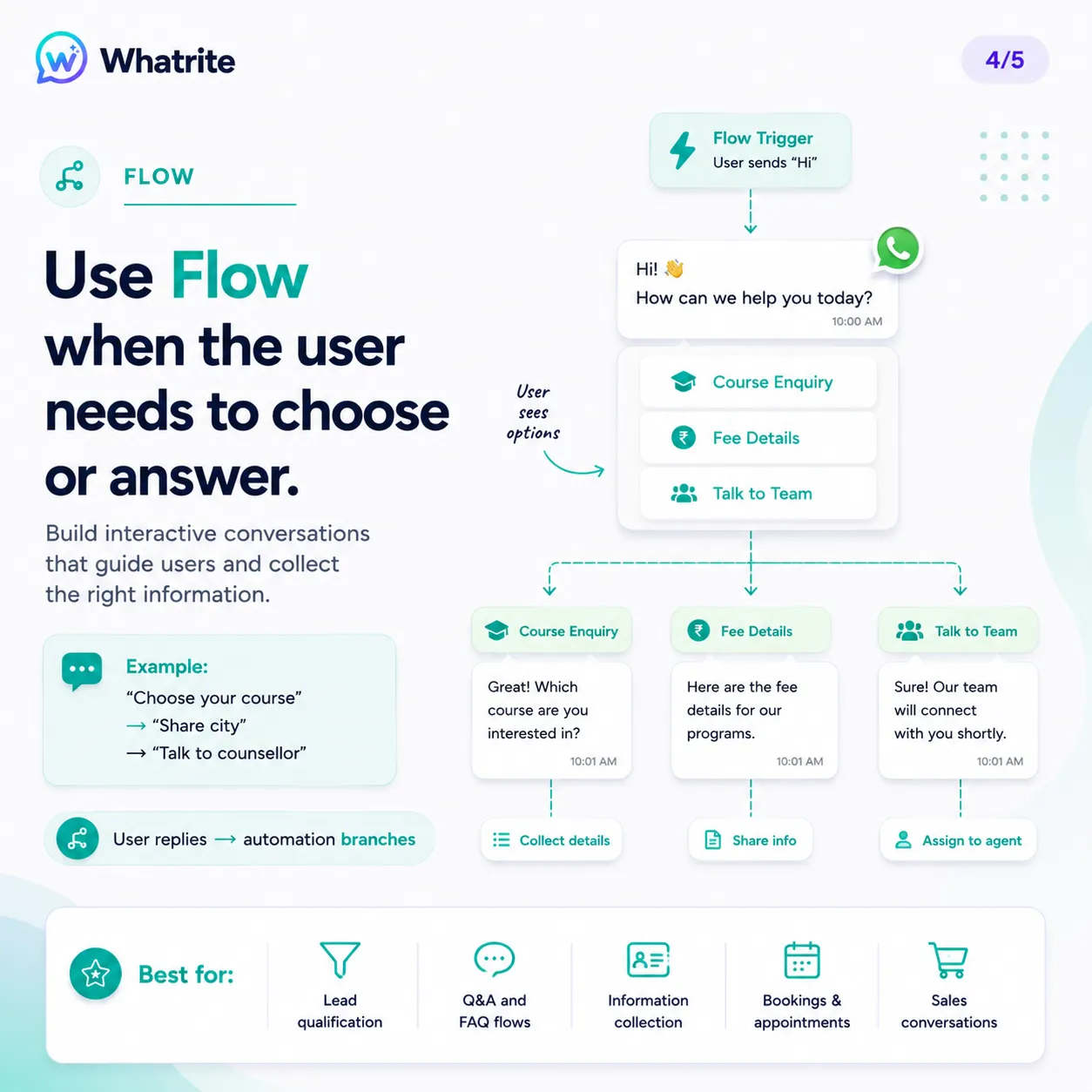
A flow is a branching conversation. Someone messages you, they see options - Course enquiry / Fee details / Talk to the team - and what happens next depends on what they tap. It collects information, it routes, it answers, and it hands off to a human at the right moment.
Use it when: you need something from the person - a choice, a detail, a qualification answer, a booking - or when the right reply genuinely differs by segment.
Two things make flow structurally different. First, running inside an open window on free-form messages means no template-approval overhead and no per-message marketing cost. Second, it's the only one of the three that creates data. A broadcast tells you who clicked. A flow tells you which course they want, which city they're in, what budget they named - and that data is what makes your next drip and your next broadcast segment worth sending.
Which is why the front door matters. A Click-to-WhatsApp ad drops a prospect straight into an open window with intent already attached - the cheapest, warmest place a flow can start. Pair it with instant reply and you've closed the gap we wrote about in automating lead response in 60 seconds.
The failure mode: dead ends. A branch that leads nowhere, a free-text answer the bot can't parse, a question the flow was never designed for. Every flow needs a visible escape hatch to a human - and if your FAQ surface is wide, that's the point where an AI bot trained on your own knowledge base earns its place, catching the questions your branches didn't anticipate.
The quick rule
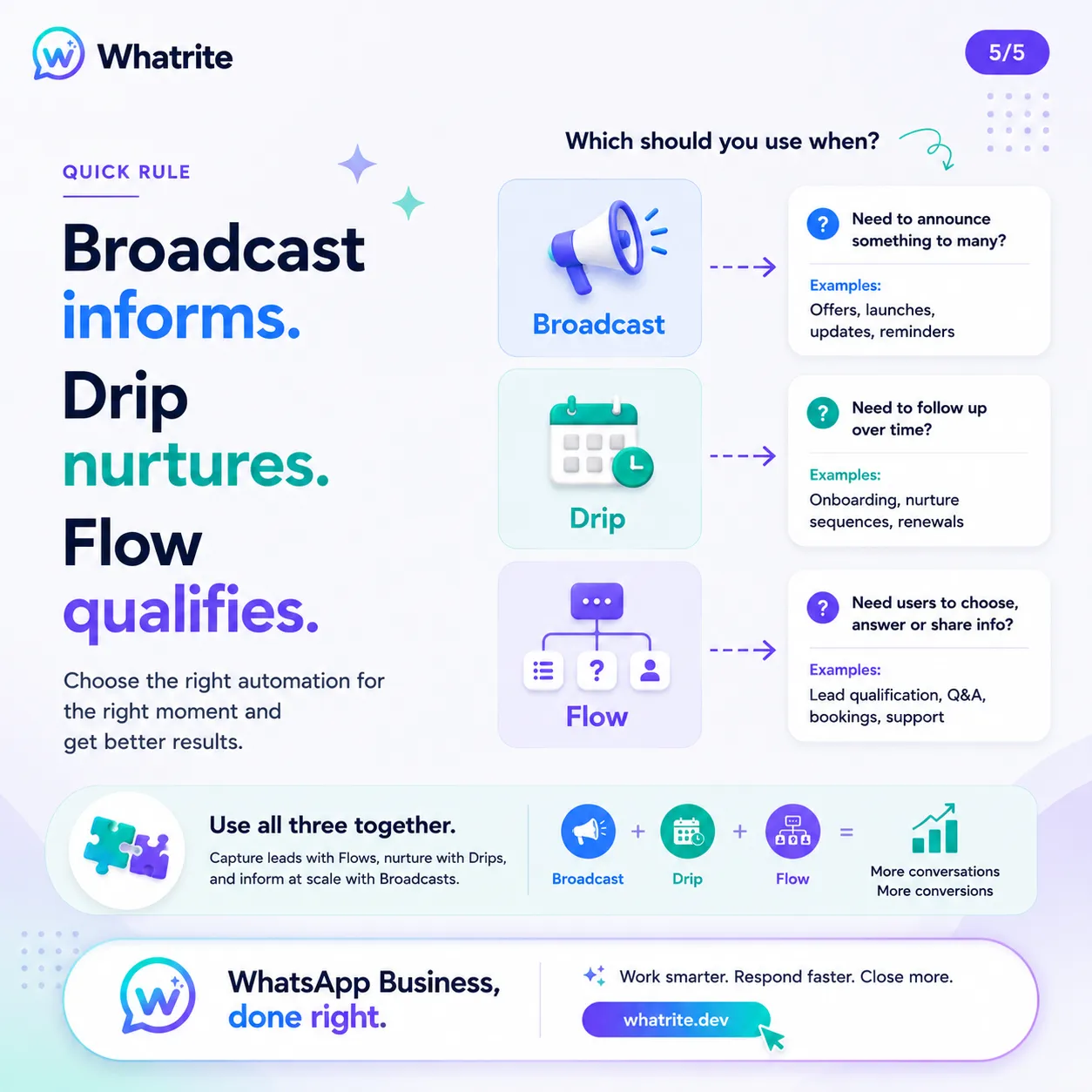
Broadcast informs. Drip nurtures. Flow qualifies.
A shortcut when you're mid-decision: ask what the next message depends on. Nothing → broadcast. Elapsed time → drip. The customer's answer → flow.
The cost logic (and why the order matters)
The three tools sit on very different cost curves, and that should shape your architecture more than any feature comparison.
At Indian marketing rates of roughly ₹0.86 per message, a broadcast to 50,000 contacts is a ₹43,000 decision made in one click. A five-step drip across 2,000 leads is ₹8,600 - spread over weeks, and only fired at people who already raised a hand. A flow that runs after an inbound message costs nothing per message at all. (Provider markups change these numbers; we broke the arithmetic down in the true cost of the WhatsApp Business API in India)
The implication is an ordering principle: spend as little as possible to open the window, then do as much as possible inside it. Earn the inbound - ads, QR codes, website button, one well-targeted broadcast - then let the flow do qualification work that would otherwise have cost a dozen outbound templates. Teams that invert this, broadcasting hard and building no flows, pay the most per qualified lead and take the most quality-rating damage doing it.
How they work together
In practice you don't choose one. You build a loop:
1. Flow captures. An inbound lands - from an ad, a QR code, a website button - and a flow qualifies it, tags it, and routes it to the right person.
2. Drip nurtures. Leads that don't convert in the conversation get enrolled into a sequence built from what the flow learned. Exit conditions kill the sequence the moment they re-engage.
3. Broadcast informs. Your whole opted-in base hears about the things that are genuinely for everyone — and because your flows have been tagging people all along, "everyone" is actually a segment.
Each feeds the next: flows generate the data that makes drips relevant, drips reopen conversations that flows then handle, broadcasts refill the top. A coaching institute running admissions is the clearest version of this loop, but the shape holds for real estate, clinics and D2C support alike.
FAQ
Is a WhatsApp broadcast the same as a broadcast list?
No. Broadcast lists in the WhatsApp Business app cap at 256 contacts and only reach people who have saved your number. A Business API broadcast uses approved templates, has no such cap, and reports delivery and read status per contact.
Can a drip campaign run without approved templates?
Only for messages that land inside an open 24-hour window. Because drips are designed to reach people who have gone quiet, assume every step needs a template.
Do WhatsApp flows cost money?
There's no per-message marketing charge for free-form replies inside an open window. Your cost is whatever it took to get that inbound message in the first place.
Which one should a small team build first?
The flow. It's the cheapest to run, it protects your quality rating instead of risking it, and it produces the segmentation data that makes your first broadcast and first drip worth sending.
The takeaway
Broadcast, drip and flow aren't competing features - they're three positions on the same timeline. Flow handles the conversation you're already in. Drip handles the one that went quiet. Broadcast starts the one that hasn't begun.
Pick by asking what the next message depends on, build the flow first, and give every drip an exit.
Whatrite runs broadcasts, drips and flows on one WhatsApp Business API platform — with no markup on Meta's messaging rates. See how it works.